|
|
||||||||||||||||
|
||||||||||||||||
|
||||||
|
|
|
|
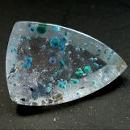
Gilalite
(inclusions
in Quartz) |
|
| | |
| Discovered in 1979; IMA status: Valid (IMA approved 1980) | ||
|
| ||
|
Chemistry |
|
|
| |
|
Cu5Si6O17 · 7(H2O) (in Quartz - SiO2) | |
|
|
Hydrated Copper Silicate (in Quartz) |
|
Molecular Weight: |
884.34 gm |
|
Composition: |
Copper |
35.93 % |
Cu |
44.97 % |
CuO |
|
|
Silicon |
19.06 % |
Si |
40.77 % |
SiO2 |
|
|
Hydrogen |
1.60 % |
H |
14.26 % |
H2O |
|
|
Oxygen |
43.42 % |
O |
|
|
|
|
|
100.00 % |
|
100.00 % |
= TOTAL OXIDE |
|
|
|
||||
|
Classification |
|
|
| |
|
Silicates (Germanates) | |
|
8/D.06-10 | |
|
|
9 : SILICATES (Germanates)
|
|
Related to: |
Chemically very similar to Apachite Cu9Si10O29•11(H2O) |
|
Varieties: |
None |
|
Synonyms: |
IMA1979-021 |
|
|
|
|
Crystal Data |
|
|
|
|
|
Monoclinic (probable) |
|
|
As spherules of radial fibers, to 0.3 mm. |
|
|
None |
|
|
|
|
|
Physical Properties |
|
|
|
|
|
n/a |
|
|
n/a |
|
|
Waxy or gummy |
|
|
2.0 |
|
|
2.72 (g/cm3) |
|
|
None |
|
|
Not Radioactive |
|
|
|
|
|
Optical Properties |
|
|
|
|
|
Chrysocolla-green, inclining to pale blue-green. |
|
|
Transparent to Translucent |
|
|
Nonmetallic |
|
|
1.560 - 1.635 Biaxial ( - ) |
|
|
0.075 |
|
|
None |
|
|
Weak in drab grayish green |
|
|
|
|
|
Occurances |
|
|
|
|
|
Geological Setting: |
A retrograde metamorphic or mesogene mineral formed at the expense of a prograde calc-silicate and sulfide assemblage; in tactites, commonly incrusting fractures; also filling cracks or interstices in diopside grains (Christmas, Arizona, USA). |
|
Common Associations: |
Kinoite, Apachite, Stringhamite, Junitoite, Clinohedrite, Xonotlite, Diopside, Apophyllite, Calcite, Tobermorite (Christmas, Arizona, USA). |
|
Common Impurities: |
Mn, Mg, Ca |
|
Type Locality: |
Christmas Mine (Red Bird shafts; Inspiration Mine; Hackberry shafts), Christmas, Christmas area, Banner District, Dripping Spring Mts, Gila County, Arizona, USA |
|
Year Discovered: |
1979 |
|
View mineral photos: | |
|
|
|
|
More Information |
|
|
|
|
|
| |
|
|
|
|
Locations
for finding Gilalite: São José da Batalha, Salgadinho,
Borborema mineral province, Paraíba, Ceará, Brazil;
Lavrion District slag localities, Lavrion District,
Attiki Prefecture, Greece. In the USA: Christmas Mine,
Banner District, Dripping Spring Mountains, Gila County,
Arizona and and the Lonestar deposit, near Safford,
Graham County, Arizona; Boss Mine, Goodsprings District,
Nevada. |
|
|
We
have not photographed our Gilalite gems yet. Please
check back soon. |
