Click on a letter above to view the list of gems.  


Californite  (variety of Vesuvianite)
Current inventory:  1 gem
 

Californite

Chemistry:  Ca19Al4Fe(Al,Mg,Fe)8Si18O7

Discovered in 1795;   IMA status: Not Valid (Vesuvianite is Valid; Grandfathered).
Californite is named after its occurance in California. The name Vesuvianite is after its locality of discovery on Mt. Vesuvius, Campania, Italy.


Classification


Mineral Classification:

Silicates

Strunz 8th Ed. ID:

8/C.26-10


8 : Silicates
C : Sorosilicates, with [Si2O7]6-, without anions unfamiliar to tetraheders
26 : Vesuvianite series


Crystal Data


Crystallography:

Tetragonal - Dipyramidal

Crystal Habit:

Vesuvianite: Crystals commonly as short pyramidal to long prismatic crystals, to 15 cm, morphologically complex, with up to 30 forms reported on one crystal; columnar, granular, massive. Californite is found in massive form, not as crystals.

Twinning:

Vesuvianite: Twinned domains observed at a very fine scale.


Physical Properties


Cleavage:

[110] Indistinct, [100] Indistinct, [001] Indistinct

Fracture:

Irregular, Uneven, Sub-conchoidal

Tenacity:

Brittle

Moh's Hardness:

6.0 - 7.0

Density:

3.32 - 3.47 (g/cm3)

Luminescence:

None

Radioactivity:

Not Radioactive


Optical Properties


Color:

Green, Yellowish Green

Transparency:

Transparent, Translucent, Opaque

Luster:

Vitreous, Resinous

Refractive Index:

1.698 - 1.742  Uniaxial ( -/+ ) and Biaxial

Birefringence:

0.0040 - 0.0060

Dispersion:

Strong; 0.019 - 0.025

Pleochroism:

Weak; O = colorless to yellowish, E = yellowish, greenish, brownish.


Occurances


Geological Setting:

Vesuvianite: In skarns formed during contact or regional metamorphism of limestones; in garnetized gabbros, mafic and ultramafic rocks, and serpentinites; uncommon in alkalic igneous rocks.

Type Locality:

Monte Somma, Somma-Vesuvius Complex, Naples Province, Campania, Italy

Year Discovered:

Vesuvianite: 1795

View mineral photos:

Idocrase Mineral Photos and Locations


More Information


Mindat.org
Webmineral.com


Californite, also known as California Jade, American Jade or Vesuvianite Jade, is a rare variety of Vesuvianite that is only found in California.
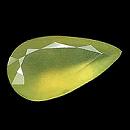
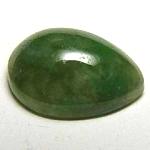
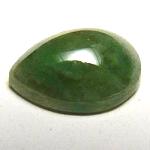
This bright green translucent to opaque material comes from several locations in and around Happy Camp, Siskiyou County; at the Pulga deposit, Butte County; and at Sky Blue Hill, Crestmore, Riverside County, California, USA. It is usually found as opaque, massive material suitable for cabochons, rarely as facet grade crystals. The cabochons are very attractive and look very similar to Jade. Faceted gems are usually translucent and silky and may resemble green Prehnite. Vesuvianite (also known as Idocrase) is found in colors ranging from green to brown and rarely blue (Cyprine).


Californite gems for sale:

Californite-001

Gem:

Californite (Vesuvianite)

Stock #:

CALIF-001

Weight:

3.1415 ct

Size:

10.70 x 7.71 x 4.52 mm

Shape:

Pear Cabochon

Color:

Green

Clarity:

Opaque

Origin:

Happy Camp, California, USA

Treatment:

None (natural)

Price:

$65.00

Pictures are of the actual gem offered for sale.
Gem images are magnified to show detail.

Californite-001

A beautiful Californite (Vesuvianite) cabochon with great color from Happy Camp, California, USA.


I love Sarah