|
ClassicGems.net |
|
|
 |
| Columbite-(Fe) (Ferrocolumbite) |
|
|
Discovered in 1928; IMA status: Valid (pre-IMA; Grandfathered) | |||
|
|
|
Chemistry |
|
|
| |
|
Fe2+Nb2O6 | |
|
|
Iron Niobium Oxide |
|
Molecular Weight: |
337.66 gm |
|
Composition: |
Niobium |
55.03 % |
Nb |
78.72 % |
Nb2O5 |
|
|
Iron |
16.54 % |
Fe |
21.28 % |
FeO |
|
|
Oxygen |
28.43 % |
O |
|
|
|
|
|
100.00 % |
|
100.00 % |
= TOTAL OXIDE |
|
|
|
||||
|
Classification |
|
|
| |
|
Oxides | |
|
4/D.18-30 | |
|
|
4 : OXIDES (Hydroxides, V[5,6] vanadates, arsenites, antimonites, bismuthites, sulfites, selenites, tellurites, iodates)
|
|
Related to: |
Columbite-(Fe)-Tantalite-(Fe) Series. Columbite-(Fe)-Columbite-(Mn) Series. Formerly known as Ferrocolumbite. |
|
Varieties: |
None |
|
Synonyms: |
Baierine, Baierite, Coltan, Columbate, Columbite, Dianite (of Kobell), Ferrocolumbite, Ferroilmenite, Greenlandite, Niobite, Torrelite |
|
|
|
|
Crystal Data |
|
|
|
|
|
Crystals short prismatic or equant, also flat tabular, to 0.75 m. In groups of parallel or subparallel crystals, to 18 t; massive. |
|
|
Common as heart-shaped contact and penetration twins, on {021} and {023}, may produce pseudohexagonal trillings. More rarely on {051} and {15•1•0}. |
|
|
|
|
|
Physical Properties |
|
|
|
|
|
Distinct on {100}, less distinct on {010}. |
|
|
Irregular/uneven, sub-conchoidal |
|
|
Brittle |
|
|
6.0; VHN = 652-739 (100 g load) |
|
|
5.20 - 6.65 (g/cm3) |
|
|
None |
|
|
Not Radioactive |
|
|
Other: | |
|
|
|
|
Optical Properties |
|
|
|
|
|
Black to brownish black. Reddish brown in transmitted light. |
|
|
Opaque |
|
|
Vitreous, sub-metallic; commonly tarnishes to iridescent |
|
|
Biaxial ( - ); R1–R2: (400) 18.4–19.1, (420) 17.7–18.6, (440) 17.3–18.2, (460) 17.1–17.9, (480) 16.9–17.7, (500) 16.9–17.6, (520) 16.8–17.5, (540) 16.8–17.4, (560) 16.7–17.3, (580) 16.7–17.2, (600) 16.7–17.2, (620) 16.6–17.1, (640) 16.5–17.1, (660) 16.4–16.9, (680) 16.3–16.8, (700) 16.1–16.8 |
|
|
0.000 (opaque) |
|
|
r < v |
|
|
None |
|
|
In reflected light: grayish white with a brownish tint and reddish internal reflections. |
|
|
|
|
|
Occurances |
|
|
|
|
|
Geological Setting: |
An accessory constituent of granite pegmatites; rarely in carbonatites; a detrital mineral in placer deposits. |
|
Common Associations: |
Albite, Microcline, Beryl, Lepidolite, Muscovite, Tourmaline, Spodumene, Lithiophilite, Triphylite, Amblygonite, Triplite, Apatite, Samarskite, Microlite, Cassiterite |
|
Common Impurities: |
None |
|
Type Locality: |
Green's Well pegmatite (Green's Tank), Pilgangoora, Wallareenya Station, Port Hedland Shire, Western Australia, Australia |
|
Year Discovered: |
1805 |
|
View mineral photos: | |
|
|
|
|
Unusual Gem Categories |
|
|
|
|
|
| |
|
|
|
|
More Information |
|
|
|
|
|
| |
|
|
|
|
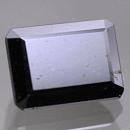
Columbite-(Fe) is a fairly common mineral but rarely available as a faceted gem mostly because it is opaque black to brownish black. However, it can be somewhat attractive with its vitreous to sub-metallic luster and when its surfaces tarnish and become iredescent. Columbite-(Fe) is relatively hard with a Mohs hardness of 6.0 and very dense. It is another of the black gems for collectors of the unusual. Columbite-(Fe) was originally named Columbite (without the -Fe suffix) in 1805 by Scottish naturalist and mineralogist Robert Jameson (1774-1854) for its columbium content. The element columbium (Cb) was discovered and named in 1801 by English chemist Charles Hatchett (1765–1847) after Columbia, the historical and poetical name for America, where it was first found. The name Columbia was derived from, and in honor of, Christopher Columbus, discoverer of America. Columbium was the original, but now obsolete, name of the element niobium (Nb). Columbium was "rediscovered" in 1844 by German chemist Heinrich Rose (1795-1864) who named it niobium from the Greek mythological figure Niobe, a daughter of Tantalus, and the Greek symbol of eternal mourning. The element columbium (Cb) was eventually assigned the name niobium (Nb) in 1950 by the International Union of Pure and Applied Chemistry (IUPAC). The mineral Columbite was renamed Ferrocolumbite in 1844 by American mineralogist Charles Upham Shepard (1804-1886) for its ferrous iron (Fe) content. Ferrocolumbite was eventually renamed Columbite-(Fe) by the IMA Commission on New Minerals, Nomenclature and Classification (CNMNC) in September, 2007 (proposal IMA 07-C) and published in an article titled "Tidying up Mineral Names: an IMA-CNMNC Scheme for Suffixes, Hyphens and Diacritical Marks" in the Mineralogical Record, vol. 39, No. 2, pages 131-135 (March - April, 2008). A mineral with the same chemical composition as Columbite was named Niobite in 1845 by Austrian mineralogist Wilhelm Karl Ritter von Haidinger (1795-1871) for its niobium (Nb) content. But the Columbite name had historical precedence and remains to this day. So, even though the name of the element which inspired the name Columbite was changed from columbium to niobium, the mineral name remains Columbite and the name Niobite, which was inspired by the current name of the element, was abandoned. Go figure. Distribution of Columbite-(Fe): in the USA, in Connecticut, at Middletown, Portland, and Haddam, Middlesex County; large masses from the Beecher Lode, eight km southeast of Custer, Custer County, and around Keystone, Pennington County, South Dakota; in the Spruce Pine district, Mitchell County, and the Foote mine, Kings Mountain, Cleveland County, North Carolina. At Ånneröd, Tveit, and elsewhere in Norway. In Russia, from Miass, Ilmen Mountains, Southern Ural Mountains. At Craveggia, Val Vigezzo, Piedmont, Italy. Large crystals from Ambatofotsikely and Antsirabe, Madagascar. At Greens Well, Wodgina, Greenbushes, and elsewhere in Western Australia. In the Ishikawa district, Fukushima Prefecture, Japan. |
|
|
Columbite-(Fe) gems for sale: We have not photographed our Columbite-(Fe) gems yet. Please check back soon. |
