|
|
||||||||||||||||
|
||||||||||||||||
|
||||||
|
|
|
|
Cinnabar
|
|
| | |
| Discovered around 800 AD; IMA status: Valid (pre-IMA; Grandfathered) | ||
|
| ||
|
Chemistry |
|
|
| |
|
HgS | |
|
|
Mercury Sulfide |
|
Molecular Weight: |
232.66 gm |
|
Composition: |
Mercury |
86.22 % |
Hg |
|
|
|
|
Sulfur |
13.78 % |
S |
|
|
|
|
|
100.00 % |
|
|
|
|
|
|
||||
|
Classification |
|
|
| |
|
Sulfides | |
|
2/C.18-10 | |
|
|
2 : SULFIDES and SULFOSALTS (sulfides, selenides,
tellurides; arsenides, antimonides, bismuthides; sulfarsenites,
sulfantimonites, sulfbismuthites, etc.) |
|
Related to: |
Trimorphous with Metacinnabar and Hypercinnabar |
|
Varieties: |
Corallinerz |
|
Synonyms: |
Cinnabarite (of Dana), Llimpi, Merkurblende, Minium (of Pliny), Vermeil |
|
|
|
|
Crystal Data |
|
|
|
|
|
Rhombohedral crystals, to 10 cm; thick tabular {0001}; stout to slender prismatic || [1010]. Also as incrustations, granular, and massive. |
|
|
Twin plane {0001}, twin axis [0001], to form simple contact twins. |
|
|
|
|
|
Physical Properties |
|
|
|
|
|
Perfect on {1010} |
|
|
Sub-Conchoidal, Irregular/Uneven |
|
|
Slightly Sectile |
|
|
2.0 - 2.5 |
|
|
VHN Hardness: |
82–156 (10 g load) |
|
8.176 - 8.200 (g/cm3) |
|
|
Not Fluorescent |
|
|
Not Radioactive |
|
|
Health Warning: |
CAUTION: Contains Mercury - always wash hands after handling. Do not inhale dust and use caution when breaking. Do not lick or ingest. Do not heat in unventilated environment - emits toxic Hg fumes. Mercury Sulfide is, however, relatively insoluble and toxicity of the pure material is low. But be aware that many samples of Cinnabar, especially those which are 'massive' rather than crystalline, also contain traces of native mercury, and this is far more easily absorbed by the body. |
|
|
|
|
Optical Properties |
|
|
|
|
|
Vermilion red, brownish red, lead gray |
|
|
Transparent to Translucent; Transparent in thin pieces |
|
|
Adamantine; inclining to metallic when dark; dull to earthy in massive varieties |
|
|
nω = 2.905; nε = 3.256 Uniaxial ( + ) |
|
|
0.351 |
|
|
Strong; over 0.40 |
|
|
None |
|
|
High |
|
|
|
|
|
Occurances |
|
|
|
|
|
Geological Setting: |
Formed from low-temperature hydrothermal solutions in veins, and in sedimentary, igneous, and metamorphic host rocks. |
|
Common Associations: |
Mercury, Realgar, Pyrite, Marcasite, Stibnite, Opal, Chalcedony, Barite, Dolomite, Calcite |
|
Common Impurities: |
None |
|
Type Locality: |
Ancient; probably India |
|
Year Discovered: |
Ancient; around 800 AD |
|
View mineral photos: | |
|
|
|
|
More Information |
|
|
|
|
|
| |
|
|
|
|
Because of its mercury content, Cinnabar can be toxic to human beings. Overexposure to mercury, called mercurialism, was considered by the ancient Romans as an occupational disease for miners. Mining in the Spanish Cinnabar mines of Almadén was regarded as being a death sentence due to the shortened life expectancy of the miners, who were slaves or convicts. Distribution:
The most common ore of mercury world-wide, so only a
few localities for exceptionally abundant or well-crystallized
material can be mentioned. In the USA, in California,
notably at New Almaden, Santa Clara County and New Idria,
San Benito County; in Texas, at Terlingua, Brewster
County; in Nevada, at the Cahill mine, Poverty Peak
district, Humboldt County, and near Lovelock, Pershing
County At Charcas, San Luis Potosí, Mexico. In Spain,
from Almadén, Ciudad Real Province, and Mieres, Asturias.
At Hydercahn, in the Fergana basin, Kazakhstan. From
Tongrin, Wanshanchang, and elsewhere in Guizhou Province,
and in exceptional twinned crystals from the Tsar Tien
mine, Hunan Province, China. As fine crystals at Mount
Avala, near Belgrade, Serbia. From Idrija (Idria), Slovenia.
|
|
|
We
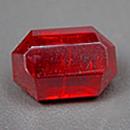
have not photographed our Cinnabar gems yet. Please
check back soon. |
